Episode 12: Daniel Donskoy // Music and literature

A Notebook for Every Art Form

Daniel Donskoy moves effortlessly between music, acting and literature. Notebooks are where his melodies first take shape, characters begin to breathe and fleeting thoughts find a place to land.

Liquid error (blocks/_video_player line 26): invalid url input

Mr Donskoy, you are a musician, actor and writer. Which of your art forms rely on notebooks?
Pretty much all of them, to be honest. They’re most essential for my music. When I write songs, I need to put them on paper with a pen. Even the physical movement of the pen influences the melody that comes to me. Calligraphy, in a way, shapes how I understand the musicality of an idea.

How did you write your book “Brennen” (Burning)? 
The actual manuscript was written on a computer, but everything before and after happened by hand. I went through old notes, diaries and letters while developing the story. As soon as parts of the manuscript were finished, I printed them out and annotated them by hand. Later, during the editing process, I transferred my notes into notebooks. 

How important are notebooks in your daily life?
I always carry at least one with me. Sometimes I overhear a sentence on the street and write it down immediately. On my desk, I keep different notebooks for different purposes: one for music, one for writing, one for organisation.

"When I write songs, I have to put them down on paper by hand. The movement of the pen shapes the melody."

Do you keep all your notes?

Every once in a while I get rid of some sketchbooks when there are simply too many of them. At the moment, I have eleven books at my workplace alone. However, it’s another story when I lose one or leave one somewhere. Then I sometimes mourn it for a week.

Why do you use so many notebooks at the same time?

Because I always need one, but often forget to put it in my bag. So I frequently buy new ones. And when I go on trips my sketchbooks are my companions. I don’t like eating in restaurants by myself, but I often have to do it when I’m travelling. So it helps me to have my book on the table and be drawing at the same time. The book gives me privacy, protects me from other people’s looks and lets me forget about the rest of the world. In that moment I am having a conversation with my thoughts and ideas.

How do you organise your thoughts: moodboards, lists, mindmaps?

(Laughs) Unfortunately I don’t have a system. And even though I always tell myself I’m going to devote a book to just one project, I can’t even manage to do that. I’m often quite disciplined on the first few pages, but then another project comes along and my resolution goes down the drain. Actually, the books are witnesses of my daily routine.

Do you have any writing rituals?

My most important ritual is writing down and sketching out my ideas at night. I often wake up at night with an idea that won’t let me go until I’ve got it down on paper. That’s why there is always a sketchbook on my bedside table.

Do your handwritten texts differ from your digital ones?
Very much so. What I write by hand feels more authentic because I’m writing purely for myself. As soon as I type, I’m aware of my communication. That alone changes the text.

Do you also take notes for your work as an actor?
Absolutely. I print everything out – I really dislike reading digitally. I still read physical books; I need paper. When I work through scripts, I mark beats and rhythms, note shifts in mood or tone. My scripts look awful in the end – they’re covered in notes and drawings.

How important is the material to you? Colours? Paper?
I’m not set on anything in particular. I use small notebooks, but also large,m leather-bound ones. As long as I have paper and a pen, I’m fine.

Ballpoint pen or pencil?
I like erasable ballpoint pens. The best of both worlds.

Lined, squared or blank pages?
Lined. Otherwise I start drifting diagonally.

Do you finish a notebook before starting a new one?
No, I usually have several on the go. I start at the front, fill about a third, then turn the book around and continue from the back. In the end, there’s a third at the front and a third at the back, and I’m constantly flipping between them. At some point, I move on to a new one. A brand-new notebook puts me under pressure – as if it demands to be filled by my writing. I prefer old notebooks. I still have my very first song notebook with my earliest lyrics. I love reading what I was thinking fourteen years ago.

So you keep your notebooks?
Actually, yes. Although I once had a fire in my flat and many of them were destroyed. I still have the really old ones; they’re in my mother’s basement.

What happens when you read old notes? 
I remember the feeling I had when I wrote them. I mentioned that I worked through old diaries while writing my book – and my handwritten notes allowed me to recognise my emotional state back then. That helped me describe those emotions more accurately in the book. Writing by hand doesn’t just serve reflection; it also deepens memory. It becomes richer, more authentic.

"This connection from head to hand to paper is better than anything digital. What I write down by hand settles differently."
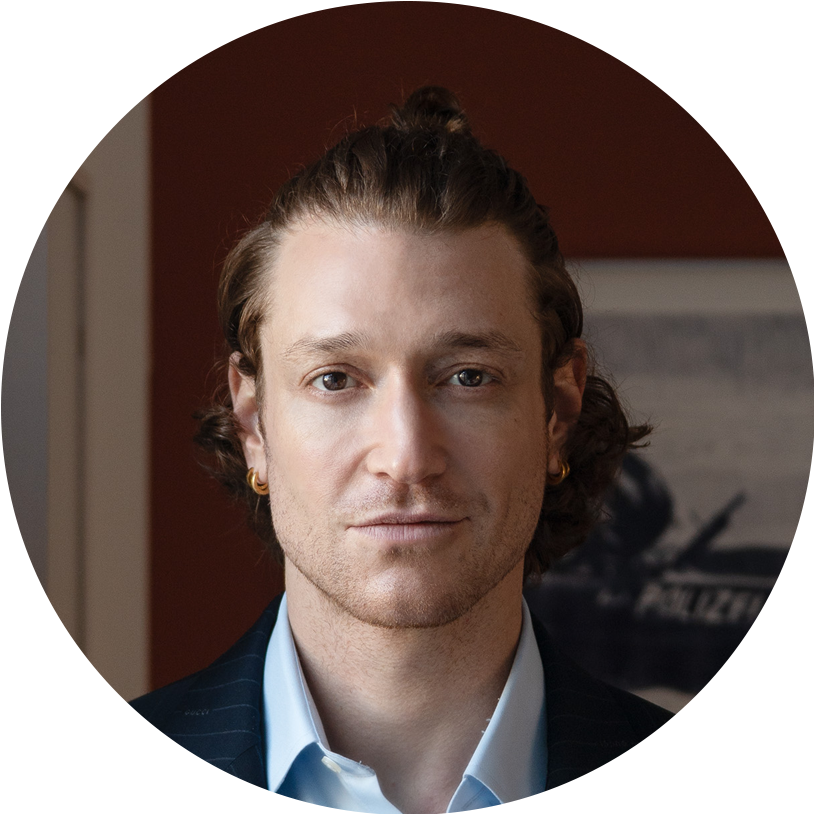
Daniel Donskoy

Daniel Donskoy, 36, is a German actor, musician, director and author. Donskoy was born in Russia in 1990, shortly after which his family fled to Berlin (his mother is from Ukraine, his father from Russia). He spent his childhood and youth in Berlin, and from 2002 onwards in Tel Aviv, where he lived with his mother. At the age of 18, Donskoy returned to Berlin, working as a bartender and model. From 2011 to 2014, he trained in acting and musical theatre at the Arts Educational School in London and spent a semester at the Lee Strasberg Institute in New York. Donskoy then went on to perform successfully in London musicals, and since 2016 he has appeared in TV, series and film productions, including “Victoria”, “The Crown” and “Strike Back”. Since February 2019, he has played the forensic pathologist Nick Schmitz alongside Maria Furtwängler in “Tatort”. In the same year, Donskoy released his first single, followed by further albums. His talk show “Freitagnacht Jews” (ARD media library and WDR) was awarded the Grimme Prize in 2022. His first novel, “Brennen”, was published in autumn 2025. Daniel Donskoy has been living in London since 2019.