Episode 14: Lukas Hoffman // Digital and Analogue

Arriving in a Notebook

Lukas Hoffmann created an app centred on reading. Through his reading circles, people come together to read in silence – free from distractions and screens. A conversation about writing by hand, the value of pen and paper, and a growing desire for focus.

Liquid error (blocks/_video_player line 26): invalid url input

Lukas Hoffmann, do you remember your first notebook?

I started doing it properly when I was about 16 or 17. I was spending a year abroad in the US, and my parents gave me a notebook to take with me. That was the moment when writing became more of a conscious act for me.

Do you keep a journal?

Not consistently. I don’t have a daily routine, but I’ve always carried a notebook with me ever since; probably because I like the idea of having a place to turn to whenever something is on my mind.

“The notebook is the place where I process things and make them tangible.”

Do you keep all your notes?

Every once in a while I get rid of some sketchbooks when there are simply too many of them. At the moment, I have eleven books at my workplace alone. However, it’s another story when I lose one or leave one somewhere. Then I sometimes mourn it for a week.

Why do you use so many notebooks at the same time?

Because I always need one, but often forget to put it in my bag. So I frequently buy new ones. And when I go on trips my sketchbooks are my companions. I don’t like eating in restaurants by myself, but I often have to do it when I’m travelling. So it helps me to have my book on the table and be drawing at the same time. The book gives me privacy, protects me from other people’s looks and lets me forget about the rest of the world. In that moment I am having a conversation with my thoughts and ideas.

How do you organise your thoughts: moodboards, lists, mindmaps?

(Laughs) Unfortunately I don’t have a system. And even though I always tell myself I’m going to devote a book to just one project, I can’t even manage to do that. I’m often quite disciplined on the first few pages, but then another project comes along and my resolution goes down the drain. Actually, the books are witnesses of my daily routine.

Do you have any writing rituals?

My most important ritual is writing down and sketching out my ideas at night. I often wake up at night with an idea that won’t let me go until I’ve got it down on paper. That’s why there is always a sketchbook on my bedside table.

Do you also jot down ideas on your mobile?

Yes, but there they simply disappear into the void. I recently tidied up my digital notes again; with many of them, I couldn’t even remember anymore what they were about. With a notebook, it’s completely different; everything has its place, and when it’s full, it’s full. I like that limitation. For the same reason, I’ve gone back to shooting on film again – taking fewer photographs but doing so more deliberately.

You founded Bookie, an app all about reading. Its users meet up for ‘Reading Parties’ to read books together offline. How does that fit together?

It seems like a contradiction: we’re building an app – yet another thing on your mobile – that’s supposed to encourage you to spend less time on your mobile. In our reading circles, people come together, put their phones away and read. Everyone reads individually, yet there is something powerful about sharing the same space. Afterwards, there’s a chance to chat, but at its heart lies quiet, focused reading. And that’s precisely what feels unusual: nothing is happening. You’re unreachable, undistracted, and yet not alone. This combination creates a surprisingly intense experience.

That sounds almost monastic: a place to step away from the constant buzz of digital life.

Exactly. You actively choose to focus, within a community. Much of our daily life takes place online, yet at the same time there is a growing desire for places where that isn’t the case. We see it in the app and at the events: many people are looking for fewer distractions and more focus, more attention, more genuine presence.

Interestingly, you also describe the notebook as a space, a place of retreat.

The notebook is calm, reduced and self-contained. And that is precisely why it is so valuable. Both the notebook and the reading circle are spaces in which less happens – and precisely because of that, more becomes possible. Spaces free from constant external influences.

What does that mean for writing by hand?

Writing with pen and paper is simpler, slower and clearer. It brings me closer to myself, and I find that deeply soothing.

“Writing with pen and paper is slower, clearer. I feel closer to myself.”
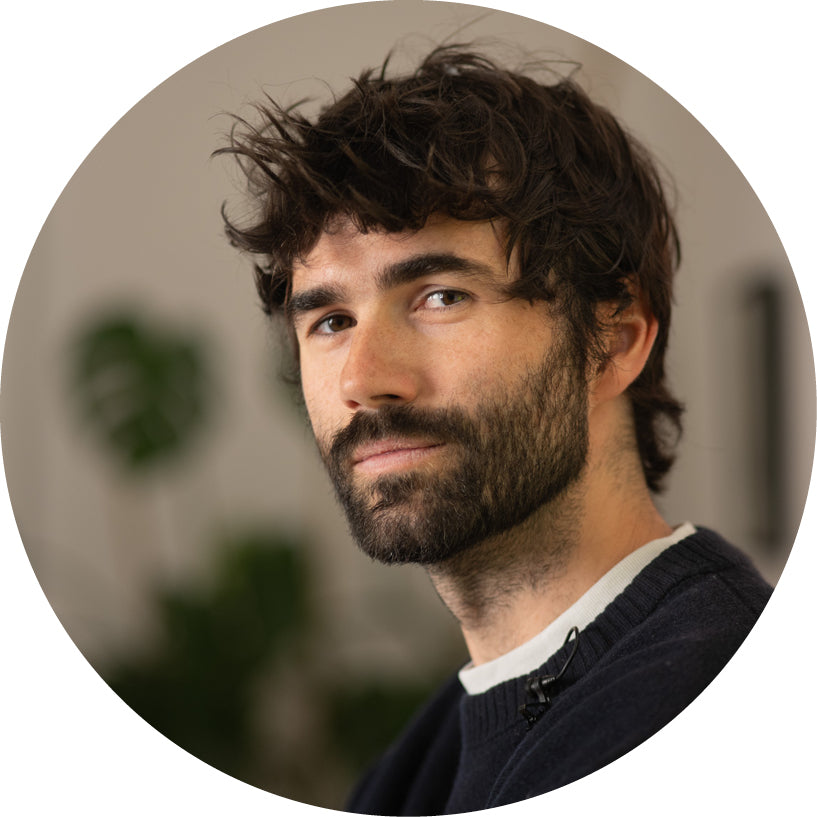
Lukas Hoffman

Lukas Hoffmann (32) is the founder of the start-up Bookie, an app that reimagines reading as a social yet focused experience. With formats such as curated reading circles, he creates spaces where people consciously go offline and concentrate on books. Bookie is a social reading app the German-speaking world that helps users establish a reading routine, makes it easy to connect with fellow readers, and enables them to discover new favourite books through friends, communities and authors. You can think of it as a bit of a cross between Duolingo and Instagram, but for books. At the same time, he works as a content creator and is deeply engaged with the question of how digital and analogue practices can be meaningfully combined. Lukas Hoffmann lives in Berlin.