Episode 10: Lisa Morgenstern // Music and film

Composing with Pen and Paper

Lisa Morgenstern is a pianist, singer and composer. She writes soundtracks for successful television series and creates complex worlds of sound. She uses pen and paper to capture many of her wonderful ideas.

Liquid error (blocks/_video_player line 26): invalid url input

Ms. Morgenstern, do you still write by hand despite all the electronics around you?
All the time. For me, writing by hand is an essential part of my thought process. To-do lists, transcripts, musical ideas – I always have a notebook with me. Writing is a way of organising my thoughts and a creative process in itself. When composing, in particular, I almost always use handwritten sketches at the beginning.

What do you write down?
Over the years, I have developed my own kind of notation system; for example, I sometimes only write down the letters of the musical notes and draw lines above them to sketch out the pattern of a melody – or I write song lyrics and draw melodic arcs under the individual syllables. Sometimes I just scribble down symbols and lines, which show the structure of a piece. This probably looks completely chaotic to other people, but for me there is a logic to it.

Why don’t you make use of digital tools?
I do work digitally, especially when I am refining my ideas. But everything begins on paper. Writing by hand creates a direct link between my intuition and the paper. It feels as though I am bringing an idea into the room – making it exist outside my own head. And by noting down my ideas in only a very rough form, I can remain flexible in my thinking. If I go back and look at a draft a few days later, the arcs and lines may arrange themselves slightly differently in my mind. This is different from digital notes, which are more fixed. The endless possibilities that the computer offers can also limit creativity.

"It is as though there is a connection between brain and hand, which ensures that what you have written down keeps on working in your subconscious."

Do you keep all your notes?

Every once in a while I get rid of some sketchbooks when there are simply too many of them. At the moment, I have eleven books at my workplace alone. However, it’s another story when I lose one or leave one somewhere. Then I sometimes mourn it for a week.

Why do you use so many notebooks at the same time?

Because I always need one, but often forget to put it in my bag. So I frequently buy new ones. And when I go on trips my sketchbooks are my companions. I don’t like eating in restaurants by myself, but I often have to do it when I’m travelling. So it helps me to have my book on the table and be drawing at the same time. The book gives me privacy, protects me from other people’s looks and lets me forget about the rest of the world. In that moment I am having a conversation with my thoughts and ideas.

How do you organise your thoughts: moodboards, lists, mindmaps?

(Laughs) Unfortunately I don’t have a system. And even though I always tell myself I’m going to devote a book to just one project, I can’t even manage to do that. I’m often quite disciplined on the first few pages, but then another project comes along and my resolution goes down the drain. Actually, the books are witnesses of my daily routine.

Do you have any writing rituals?

My most important ritual is writing down and sketching out my ideas at night. I often wake up at night with an idea that won’t let me go until I’ve got it down on paper. That’s why there is always a sketchbook on my bedside table.

For “The Empress”, you are writing for a full orchestra. In your own music, you often work with electronic synthesisers . Do you use pen and paper for these arrangements as well?
Yes, for orchestral pieces I like to use a pen to draw a kind of visual musical score for myself, before I write the actual score on the computer. I roughly sketch out where each instrument comes in, which parts overlap with one another, and where I would like to put contrasting elements. With electronic music, it is different. I love synthesisers, especially the ones without keyboards, because they force me to work intuitively. Many of my favourite sounds emerge from coincidences – sometimes even from glitches, such as a fluctuation in the electricity current that causes a small change in a melody. Such moments are precious. In order to be able to reproduce them as far as possible later on, I note down small codes and symbols.

Do you use notes for live performances as well?
Yes, especially for concerts with synthesisers. Turning the controls, switching patch cables, activating effects: so many small actions are involved that I make a kind of cheat sheet for myself, full of drawings, symbols and waves.

What happens to your notebooks when they are full?
I keep all of them – they are my personal archive. I have often looked inside an old notebook years later and discovered an idea which I did not pursue at the time. And suddenly, it makes sense.

"I have often looked inside an old notebook years later and discovered an idea which I did not pursue at the time. And suddenly, it makes sense."
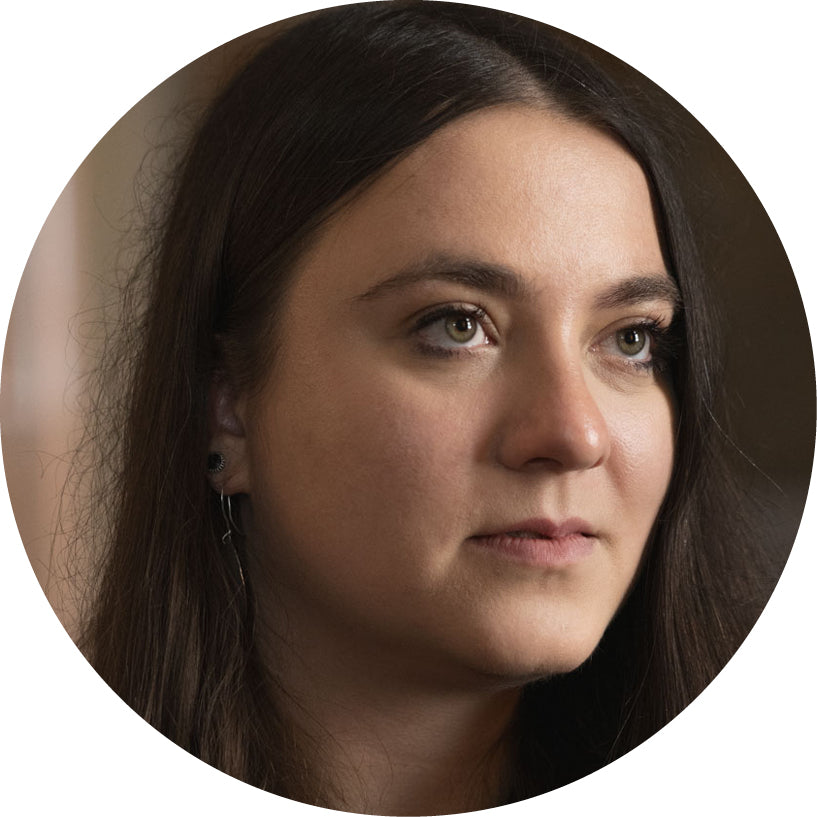
Lisa Morgenstern

Lisa Morgenstern is a German-Bulgarian composer, singer, pianist and synthesiser enthusiast. She first gained international recognition in 2019 with her album “Chameleon”, which she released herself. With impressive live performances, she has performed all over Europe and opened for artists such as Ólafur Arnalds and Max Cooper. Morgenstern has played at festivals such as SXSW in Austin, Texas, Iceland Airwaves in Reykjavík and in concert halls such as the Berlin Philharmonic and the Elbphilharmonie in Hamburg. Lisa Morgenstern wrote the soundtrack for the Netflix series “The Empress” (“Die Kaiserin”), which received an Emmy award in 2023. She also wrote and arranged the music for the second season; for this soundtrack, she led the recordings with the Reykjavík Orchestra and can be heard singing and playing piano. In addition, there have been several studio collaborations with artists such as Caspar, Balmorhea and Aukai. Lisa Morgenstern lives and works in Berlin.