Episode 8: Leonie Barth // Fashion and design

Drafting by Hand

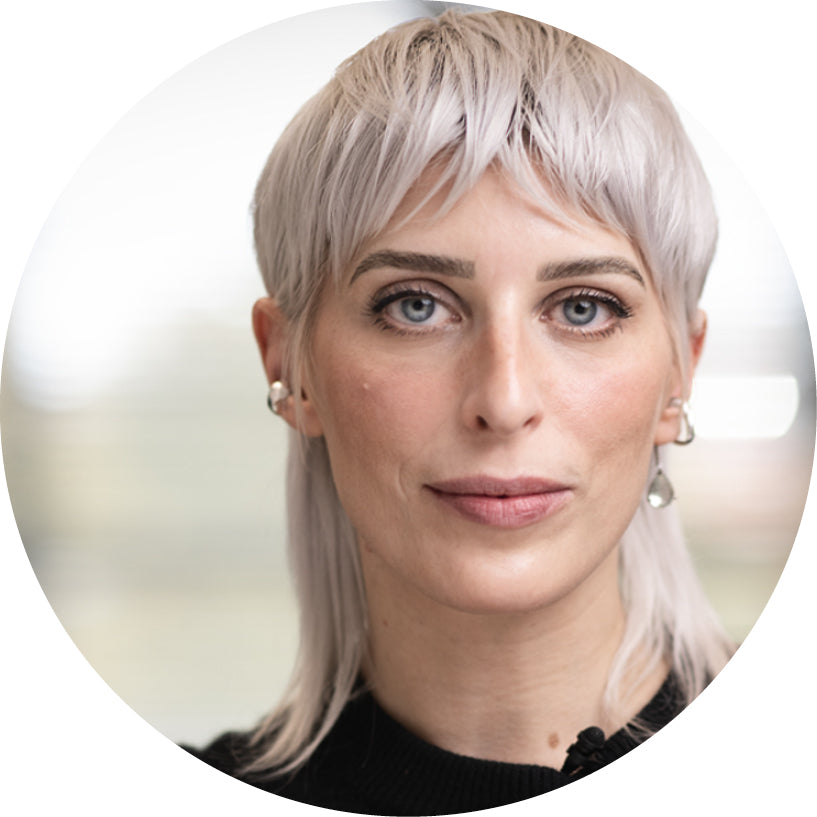
Leonie Barth is a sought-after designer of bags and shoes. She uses pencil and paper to keep track of her ideas, which pour from her by the hundred.

Liquid error (blocks/_video_player line 26): invalid url input

Ms Barth, why do you use notebooks?
I use them to record the history of my designs’ development so that I can trace it. I studied in Bielefeld, and my professor, Kai Dünhölter, drilled into us the importance of always documenting our projects.

Why is documentation so important? Isn’t the idea the most important thing in design?
But the heart of every good design is a concept. A design is never only about the end product, but always about the journey, the process: from inspiration to finished product. If you don’t document that, you can’t explain it. Notes help me to trace my trains of thought – and they help me later to explain to my clients where my ideas come from. I think that’s probably what people mean when they talk about well thought-out design.

How do notebooks help you to think about design?
They create control and creativity, both at once. A designer’s job is probably only about 30 percent creativity. Developing a new bag or a new shoe is a process of countless tiny steps, researching patterns and materials, project management, researching suppliers, organisation and coordination. My notebooks are full of to-do lists that help me keep track and control over what I need to accomplish in my daily work. The other part is to do with inventing patterns, and I draw and doodle to myself. Because of course, my first ideas are always already coming to me during my research work. If I didn’t record them, I’d lose the plot.

What kind of drawings are they?
The first drawings are rough, quick and very personal. Interestingly, a lot of creative directors get very excited about them and what they see scattered around in the notebook. They often find something in the drafts that I haven’t noticed before.

Do you use one notebook per project?
Yes. Every development project has a long timeframe, and the creative part merges with the organisation, so it’s important always to have everything at your fingertips in one place. Sometimes there are several projects in the same book, but they will all be to run with the same client. And, quite honestly, there are some notebooks that never get finished or filled up. For example, if a project doesn’t go well, the notebook will reflect that. It won’t be fat and full of inspirational things stuck in it. It’ll be pretty thin and tattered because of all the pages I’ve ripped out.

"My hand and my head are as one in the moment when I’m drawing on paper."

Do you keep all your notes?

Every once in a while I get rid of some sketchbooks when there are simply too many of them. At the moment, I have eleven books at my workplace alone. However, it’s another story when I lose one or leave one somewhere. Then I sometimes mourn it for a week.

Why do you use so many notebooks at the same time?

Because I always need one, but often forget to put it in my bag. So I frequently buy new ones. And when I go on trips my sketchbooks are my companions. I don’t like eating in restaurants by myself, but I often have to do it when I’m travelling. So it helps me to have my book on the table and be drawing at the same time. The book gives me privacy, protects me from other people’s looks and lets me forget about the rest of the world. In that moment I am having a conversation with my thoughts and ideas.

How do you organise your thoughts: moodboards, lists, mindmaps?

(Laughs) Unfortunately I don’t have a system. And even though I always tell myself I’m going to devote a book to just one project, I can’t even manage to do that. I’m often quite disciplined on the first few pages, but then another project comes along and my resolution goes down the drain. Actually, the books are witnesses of my daily routine.

Do you have any writing rituals?

My most important ritual is writing down and sketching out my ideas at night. I often wake up at night with an idea that won’t let me go until I’ve got it down on paper. That’s why there is always a sketchbook on my bedside table.

How would you describe your handwriting?
I write almost entirely in capitals, and my handwriting is technical, linear, dynamic. My notes are almost always in English.

Why is that?
I think, dream and write in english. After my studies, I went to London and started my professional career there, and stayed seven years. My first job was with Mother of Pearl, the fashion label belonging to the ex-partner of Damien Hirst. After that I moved to COS and stayed there five and a half years.

Did you use pencil and paper there?
All the designers in our teams always began by making drawings by hand.

Is that still the case? Software has been developed for tablets.
Change is happening – and actually that’s a problem. Many young designers now find it hard to draw on paper. I had a job last year teaching accessory design at the Bielefeld vocational college. I had 14 students sitting in front of me and they all had tablets. They were all keeping digital notebooks, and they were all drawing and designing in the same software. So I tried out this software (again), trying to convince myself – and again I came up against the typical digital complications. How does the pencil work? How do I set the line? How do I erase? It drives me mad. With pencil and paper, it’s different: my hand and my head are as one in the moment when I’m drawing on paper.

"When all the drawings are spread out in front of me on the desk, the good ideas are looking right at me."
Isn’t creating on a tablet just a question of habit?
I don’t think it is. When I’m on Page 20 of my project, my notebook contains a certain amount of stuff that I can access at any moment. Everything is there in front of me on my desk. On a tablet, you’re in the moment, on the surface, and tragically it always feels final. The process disappears in the digital sphere. Many of my students don’t arrive at a satisfactory end result because nothing is happening freely. So I always recommend that they take a pencil and paper and just draw it out.

What does that mean – draw it out?
When I develop a handbag, I’ll probably have drawn a hundred different handbags. It becomes an obsession. The connection between the brain, the pencil and the paper is hugely important. My head is full of thoughts and ideas. And they need to be drawn out and refined. After that, I can evaluate everything. And I can only do that in a satisfying and worthwhile way if everything is spread out in front of me on the desk. Then the good ideas are looking right at me.

Leonie Barth

Leonie Barth was born in Gütersloh in 1987. She studied fashion and design at the Bielefeld Vocational College. Immediately after graduating in 2014, she won the prestigious ITS Award at Trieste. She worked in London, at Mother of Pearl and COS, for whom she designed the “Cloud Bag”, one of the most successful products in the company’s history. Her works have been exhibited at the Museum of Modern Art Frankfurt, alongside Ettore Sottass, Dan Graham, Andy Warhol, Isa Genzken and Ólafur Elíasson. She lives with her husband in Berlin, and works as a freelance designer, designing handbags, shoes and accessories for national and international fashion labels, such as GmbH and Unvain.