Episode 5: Sarah Winkelmann // Expedition and adventure

Extreme hiker

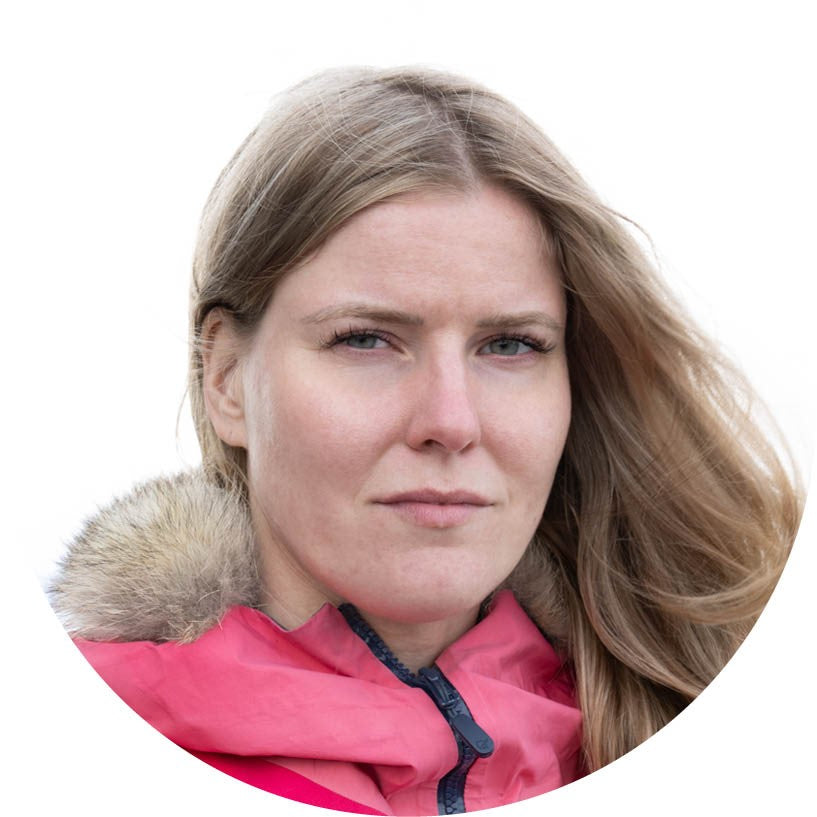
Sarah Winkelmann is 28 and pursues an extreme hobby: Arctic expeditions. She and ten other participants crossed the icy wastes of Greenland in 28 days. On every one of those days, she kept a diary. Writing helped her stay sane when going beyond her limits was the order of the day.

Liquid error (blocks/_video_player line 26): invalid url input

You crossed the icy wastes of Greenland with a notebook. What did you write?
Firstly, practical, fairly technical things. What was the weather like, where was the wind blowing from? Have I taken my medicines? Is the equipment in order? Is the tent OK? I recorded facts and to-dos every day.

How important were these notes?
They help keep your head clear. Which is a psychological effect that is not to be sniffed at on an expedition. I often had doubts early on. What if I’ve miscalculated on my food rations? What if the weather suddenly turns? In situations like that, writing things down helped me feel safe. I like to compare it with the “Pensieve” in Harry Potter: a stone basin where thoughts and memories are stored for referring back to later. My “Pensieve” is my notebook. 

Were there moments that scared you?
You can prepare and train as well as you like, plan your route, organise your equipment, take precautions for weather changes – but in the end, you’re on your own, standing on your skis in an ice desert, experiencing everything for the first time. There are things you can’t simulate in training. I knew that after two or three weeks on an expedition like this, hunger almost doubles. How will your own body react? That uncertainty is scary.

How did you deal with this fear?
I wrote it down – but always combining it with something that gave me courage. I developed a system for this after a few days. Every day, I made a note of my three greatest fears, and right next to that, three things I was most looking forward to when I got back. Often quite banal things: strawberries, pizza and asparagus, for example. So my daily notes got longer and longer.

When do you have time to write on an expedition like this?
The days are jam-packed, there’s not much spare time. I set my alarm a bit early and spent about 20 minutes writing immediately on waking up every morning, still lying in my sleeping bag. Always applying the same principle: first the facts and technical things, then a section on what we’d experienced as a group, and finally the passages about my own feelings.

"There are moments when a pencil and paper help you stay sane."

Do you keep all your notes?

Every once in a while I get rid of some sketchbooks when there are simply too many of them. At the moment, I have eleven books at my workplace alone. However, it’s another story when I lose one or leave one somewhere. Then I sometimes mourn it for a week.

Why do you use so many notebooks at the same time?

Because I always need one, but often forget to put it in my bag. So I frequently buy new ones. And when I go on trips my sketchbooks are my companions. I don’t like eating in restaurants by myself, but I often have to do it when I’m travelling. So it helps me to have my book on the table and be drawing at the same time. The book gives me privacy, protects me from other people’s looks and lets me forget about the rest of the world. In that moment I am having a conversation with my thoughts and ideas.

How do you organise your thoughts: moodboards, lists, mindmaps?

(Laughs) Unfortunately I don’t have a system. And even though I always tell myself I’m going to devote a book to just one project, I can’t even manage to do that. I’m often quite disciplined on the first few pages, but then another project comes along and my resolution goes down the drain. Actually, the books are witnesses of my daily routine.

Do you have any writing rituals?

My most important ritual is writing down and sketching out my ideas at night. I often wake up at night with an idea that won’t let me go until I’ve got it down on paper. That’s why there is always a sketchbook on my bedside table.

Do you need to use special pens in extreme cold? 
A normal ballpoint would probably still have worked in my sleeping bag in the tent, but I got used to writing above my head lying on my back, which means that the ink is flowing in the wrong direction. So the most reliable writing instrument for me is the pencil.

What happens now when you read your notes?
I actually feel a bit proud. Because the retrospective view shows me how I developed over the course of the expedition. Especially in terms of my fears. At first, they were mostly about myself, doubts about my abilities. Could I do this? Had I trained enough? And always worrying about the food rations, one of the most important and complex aspects of the planning. Later almost all that worried me was external factors. Would the weather hold? Would we meet polar bears? I can read in my notes how I was becoming steadily more self-assured.

"When I write by hand, I’m more honest with myself."
Did these very challenging experiences conjure any especially existential thoughts?
The opposite, even, to some extent. ‘Today we all sat together in a three-man tent, eating waffles and chatting’ – that was one entry, for example. Doesn’t exactly sound earth-shattering, but it was incredibly important for me at the time to experience those moments of community. Although you’re in a group on an expedition, you’re alone for most of the time. For thirty days at a stretch, you’re moving straight ahead through an almost never-changing white landscape. No animals, almost nothing to break up the monotony. So the things that are going on are mostly in your own head.

It sounds almost like being at sea or in the desert.
First and foremost, the unparalleled silence and vastness of the Greenlandic landscape, and the sense of isolation from the world, are very inspiring. You find time to think intensively about your own life, about ambitions, hopes, relationships. And if you’re lucky you find solutions for problems – and next morning you can write them down in a notebook in your sleeping bag, along with the weather data.

Did you ever consider giving up?
I never seriously wanted to give up, but there was one situation where it came very close. About halfway through the expedition, I suddenly got knee pains that were getting worse and worse. The pain was one thing, but the uncertainty was worse: what if you’re doing serious damage to yourself? There weren’t exactly any hospitals nearby. Eventually we got a doctor on the satellite phone, and he reassured me with a remote diagnosis. Up to that moment, I’d been recording all my gnawing thoughts in my notebook. There are moments when a pencil and paper help you stay sane.

Sarah Winkelmann

Sarah Winkelmann studied International Relations and Political Science at Constructor University in Bremen and Cambridge University. She lives and works as a strategic consultant in Bergen on the southwestern coast of Norway. She first tried cross-country skiing at 25, and at 27, she became the youngest German woman  to accomplish the Greenland crossing. She is already busy planning her next expedition, from the coast of the Antarctic continent to the South Pole.