Episode 13: Ju Schnee // Painting and sculpture

Ir Curls!

When Ju Schnee stops thinking, something remarkable happens: forms begin to emerge. It’s been this way all her life. Pen, paper and notebook are never far from reach. Welcome to the vivid world of the Vienna-based artist.

Liquid error (blocks/_video_player line 26): invalid url input

Ju Schnee, why curls?
I’ve been drawing since I was a child – whenever I had to listen, in class or on the phone. It was always curls, small organic shapes, without any particular aim, just flowing from my hand. My schoolbooks are full of them. For me, they’re the most natural way of making movement and thought visible. They’re intuitive, they happen without thinking – and today they form the backbone of my work.

And everything starts in notebooks? 
Yes. Keywords, quotes, sentences, lists, fragments of thought – everything first goes into notebooks. I sketch on paper, on my iPad, sometimes even on envelopes or receipts. But notebooks are my memory, my archive. In the studio, they become the starting point for my paintings and sculptures. Without them, something essential would be missing – and that is access to my spontaneous ideas.

"Every handwritten note, every sketch is a graphic trace of a reflection, an idea, a thought."

Do you keep all your notes?

Every once in a while I get rid of some sketchbooks when there are simply too many of them. At the moment, I have eleven books at my workplace alone. However, it’s another story when I lose one or leave one somewhere. Then I sometimes mourn it for a week.

Why do you use so many notebooks at the same time?

Because I always need one, but often forget to put it in my bag. So I frequently buy new ones. And when I go on trips my sketchbooks are my companions. I don’t like eating in restaurants by myself, but I often have to do it when I’m travelling. So it helps me to have my book on the table and be drawing at the same time. The book gives me privacy, protects me from other people’s looks and lets me forget about the rest of the world. In that moment I am having a conversation with my thoughts and ideas.

How do you organise your thoughts: moodboards, lists, mindmaps?

(Laughs) Unfortunately I don’t have a system. And even though I always tell myself I’m going to devote a book to just one project, I can’t even manage to do that. I’m often quite disciplined on the first few pages, but then another project comes along and my resolution goes down the drain. Actually, the books are witnesses of my daily routine.

Do you have any writing rituals?

My most important ritual is writing down and sketching out my ideas at night. I often wake up at night with an idea that won’t let me go until I’ve got it down on paper. That’s why there is always a sketchbook on my bedside table.

Has your handwriting changed?
It used to be neat, rounded, flowing – back when I still wrote with a fountain pen. Today it’s rougher, bolder. But the expression is the same: large, sweeping, fast.

You once said that chaos is important to you. How does that fit with notebooks?
Chaos and structure exist side by side. At home – accounts, bills, paintings – everything tends to be scattered about. The notebooks help me gather the creative side. They’re small anchors in an otherwise very open process.

Could you live without analogue tools?
That would be difficult. I could do without digital media, but working with my hands – drawing, making – is central to me. Sketching, painting, shaping forms with my hands: that’s non-negotiable. The hands are tools of reflection, intuition and creativity. Every shape contains the movement of my hands. From hand to paper to canvas – that’s the foundation. The digital carries that movement out into the world.

"From the hand, to the paper, to the canvas – the movement of my hands is in every shape."
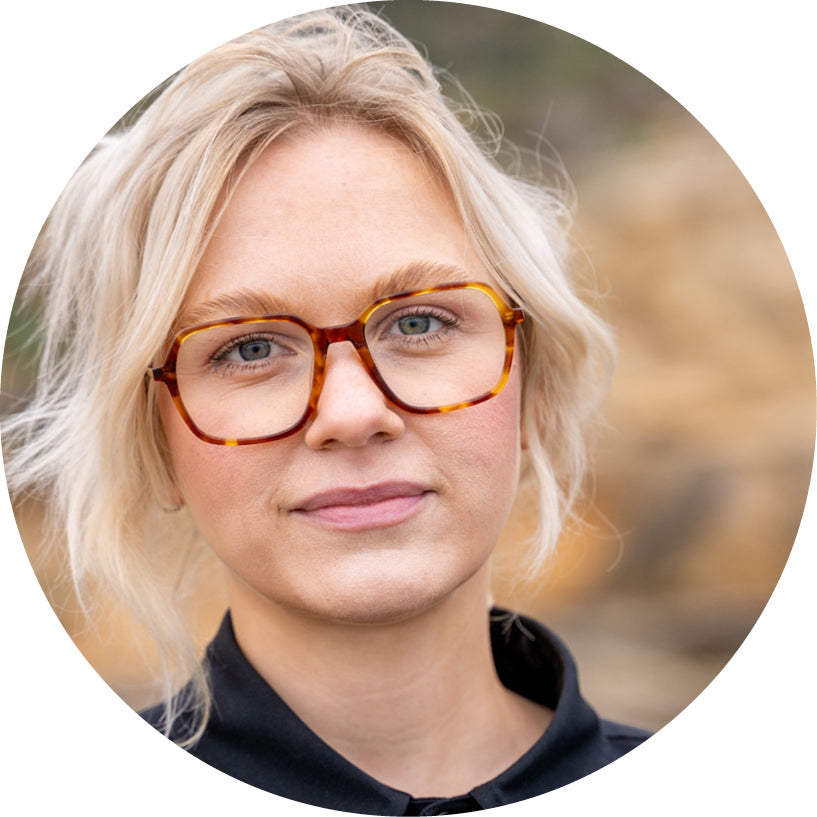
Ju Schnee

Ju Schnee (34) works across painting and sculpture, creating a distinctive, transformative space within contemporary art. Her practice brings together the tactile and the digital in a visual language that is organic, otherworldly and consistently abstract. She holds a Master of Arts from the University of Applied Sciences in Graz and has long pushed beyond traditional boundaries by combining oil painting with augmented reality (AR). Her work repeatedly returns to a core vocabulary: abstract, biomorphic shapes – on canvas, as digital flow forms and, since 2020, as sculptural objects. Her work has been shown in galleries in Los Angeles, Berlin, Vienna and Paris, as well as at art fairs including KIAF Seoul. It reflects the evolving nature of contemporary art, where tradition and innovation are not opposites but collaborators in the creation of new.