Episode 2: Norman Ohler // Literature and non-fiction

Pen, Hand, Paper

Norman Ohler’s book Blitzed, which explores drug use in the military of the Third Reich, was an instant international bestseller. His latest book, Tripped, chronicles the history of LSD. Many of his books are about intoxication. And for him, the very act of writing by hand is an intoxicating experience.

Liquid error (blocks/_video_player line 26): invalid url input

Mr. Ohler, we all like to entertain the romantic fantasy that writers today still write by hand. Does that apply to you?
Yes, it does. And it’s all thanks to Ulla Hahn.

What does the acclaimed author of Das verborgene Wort and other works have to do with it?
A long time ago she said that when she leaves her house, she always has a pen and paper with her so she’s prepared to write down thoughts and ideas that come to her at any time. I read that when I was twenty and it made an impression on me. I’ve stuck to it ever since.

When and where do you take your notes? Only when you’re out?
At the moment, yes, because I’m in the middle of writing a non-fiction book, a sort of sequel to Blitzed, and it’s easier to collect things for non-fiction books on a laptop. It doesn’t work as well by hand, unlike with novels. I use my notepad more when I’m out and inspiration strikes. I type up those notes later. Unfortunately I’m not in the same position as Peter Handke, who is still allowed to submit handwritten manuscripts. 

"When I write by hand, I produce different sorts of sentences from when I’m on the computer. I’d say they tend to be better ones."

Do you keep all your notes?

Every once in a while I get rid of some sketchbooks when there are simply too many of them. At the moment, I have eleven books at my workplace alone. However, it’s another story when I lose one or leave one somewhere. Then I sometimes mourn it for a week.

Why do you use so many notebooks at the same time?

Because I always need one, but often forget to put it in my bag. So I frequently buy new ones. And when I go on trips my sketchbooks are my companions. I don’t like eating in restaurants by myself, but I often have to do it when I’m travelling. So it helps me to have my book on the table and be drawing at the same time. The book gives me privacy, protects me from other people’s looks and lets me forget about the rest of the world. In that moment I am having a conversation with my thoughts and ideas.

How do you organise your thoughts: moodboards, lists, mindmaps?

(Laughs) Unfortunately I don’t have a system. And even though I always tell myself I’m going to devote a book to just one project, I can’t even manage to do that. I’m often quite disciplined on the first few pages, but then another project comes along and my resolution goes down the drain. Actually, the books are witnesses of my daily routine.

Do you have any writing rituals?

My most important ritual is writing down and sketching out my ideas at night. I often wake up at night with an idea that won’t let me go until I’ve got it down on paper. That’s why there is always a sketchbook on my bedside table.

What happens to the notepads?
When they’re used up they all get put into a drawer and I cross out whatever I’ve already transferred. And at some point they can all go to the literary archive in Marbach (laughs).

Do you use abbreviations or symbols that only you understand in your notes?
At journalism school in Hamburg I once learned some note-taking shortcuts from Wolf Schneider. For example, the trick of simplifying words like “person” by writing “P”. When I want to review something later, I write “doc” for “documentation”. On top of that, my handwriting is hard to decipher. If the notepads do ever get sent to the literary archive, I’ll probably have to make a key for the abbreviations…

When do your sentences come into existence? In your head, before they’re on paper? Or at the very moment you write them down?
I’m very impulsive when I write. I don’t plan anything, it all just comes out in the act of writing. I try to get myself into an altered state that could be described as a sort of rush: this “writing state” sets in and takes control of me. And when I write by hand, I produce different sorts of sentences than when I’m on the computer. I’d say they tend to be better ones. Then again, it probably also holds true that the more techniques you use, the greater your range of expression.

"I write wherever I happen to be. In the street, on the train, in nature. Back in the day I used to do a lot of writing in clubs."
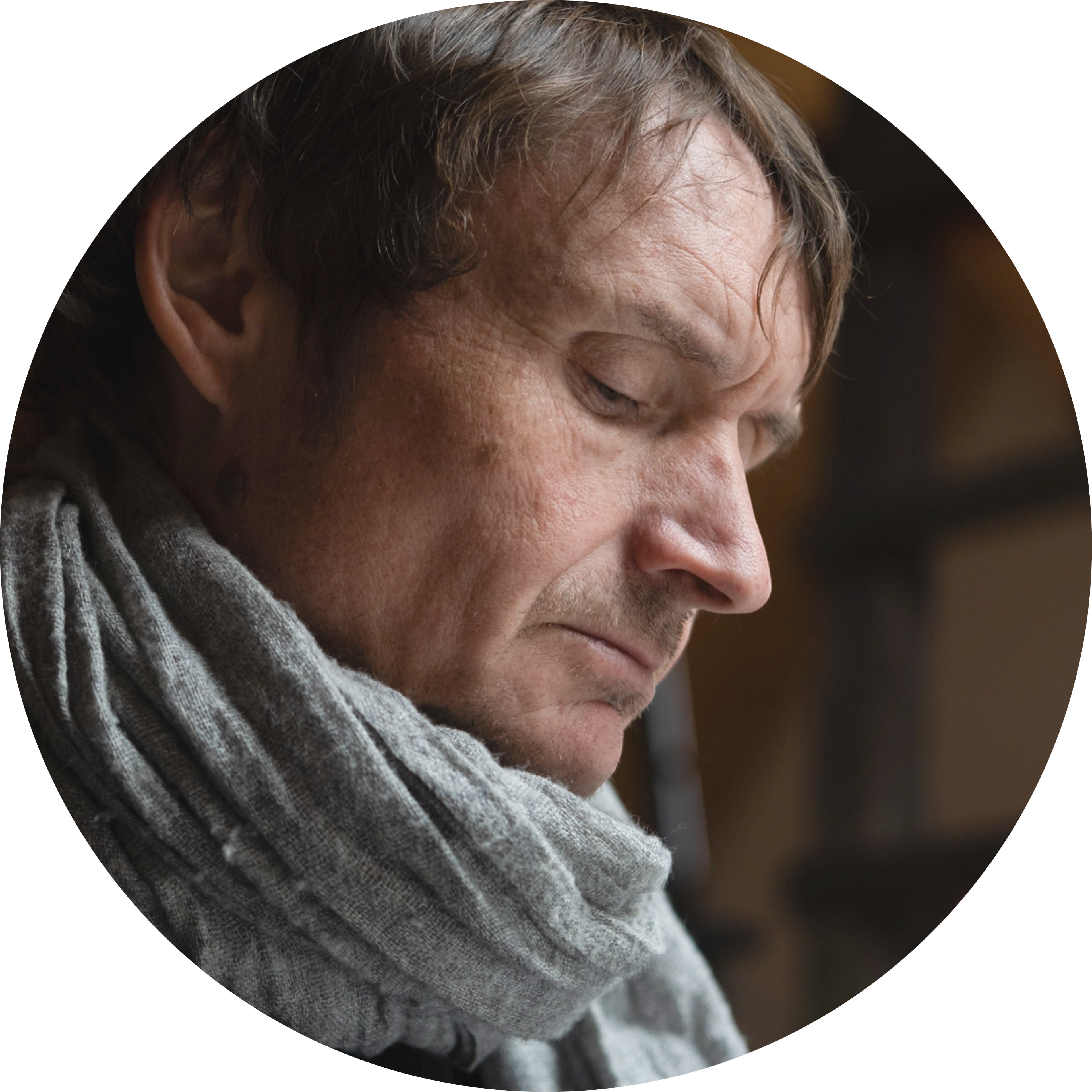
What significance does handwriting have for your work, which often references original sources? For Blitzed you had to read through piles and piles of handwritten notes by Theo Morell, Hitler’s personal physician.
His notes were near impossible to decipher at times. Handwriting like his suggests a lot of immediacy and intimacy. Later, when his notes were digitised and I could no longer view the originals, I couldn’t see or recognise anything any more – and I thought: had it been like this from the start, I probably never would’ve written the book. It was only thanks to his handwriting that I could really figure out the facts and the times. Perhaps having such an experience increased my own desire to take notes by hand.

Have you had any memorable “writing moments” recently?
I like to travel to the Nietzsche House in Sils Maria, an Alpine village in Switzerland where the philosopher lived for some years. That’s a handwriting spot. Nietzsche always claimed he wrote down all his ideas while walking in the mountains there. And I feel the most intense moments of happiness when I am in that place and I pull out my notebook to write things down. I recently took a walk to a glacier and saw it there, dying before my eyes. It was very emotional and I captured the moment in a poem right as I was standing there. Something like that only works when you write by hand, if only because it’s unlikely you’d ever lug a laptop around on a four-hour hike at nearly 10,000 feet above sea level just in case you get inspired. That was a very special and moving moment.

Norman Ohler

Norman Ohler is a writer who lives in Berlin. In the 1990s, he wrote Die Quotenmaschine, the first internet novel in literary history. In addition to a number of other novels, he published the non-fiction workBlitzed: Drugs in the Third Reich in 2015. Drawing on previously unknown original materials, Ohler explored the subject of drug use in the military of the Third Reich and by Adolf Hitler. The work was a worldwide sensation, prompting translations into more than 30 languages and landing a spot on the New York Times Best Seller list. His novelThe Infiltrators, about the leaders of a resistance group in the Third Reich, was published in 2019. Since its release in the autumn of, Tripped: Nazi Germany,the CIA, and the Dawn of the Psychedelic Age has been taking the international bestseller lists by storm.